Super Guarantee for Employers: 2026–27 Rate, Payday Super and Payment Rules


For the 2026–27 financial year, the Super Guarantee rate is 12%. Since 1 July 2026, employers also need to pay Superannuation Guarantee contributions with each pay cycle under the new Payday Super rules.
For most employers, that means superannuation is now much more closely connected to payroll. Contributions generally need to reach an employee’s super fund within seven business days of payday, and the amount is calculated using qualifying earnings, which incorporates ordinary time earnings and certain other payments.
For business owners, getting the percentage right is only part of the job. You also need to know which workers are eligible, what earnings attract super, where contributions need to be paid and what happens if a payment is late.
Super Guarantee 2026–27: the key rules
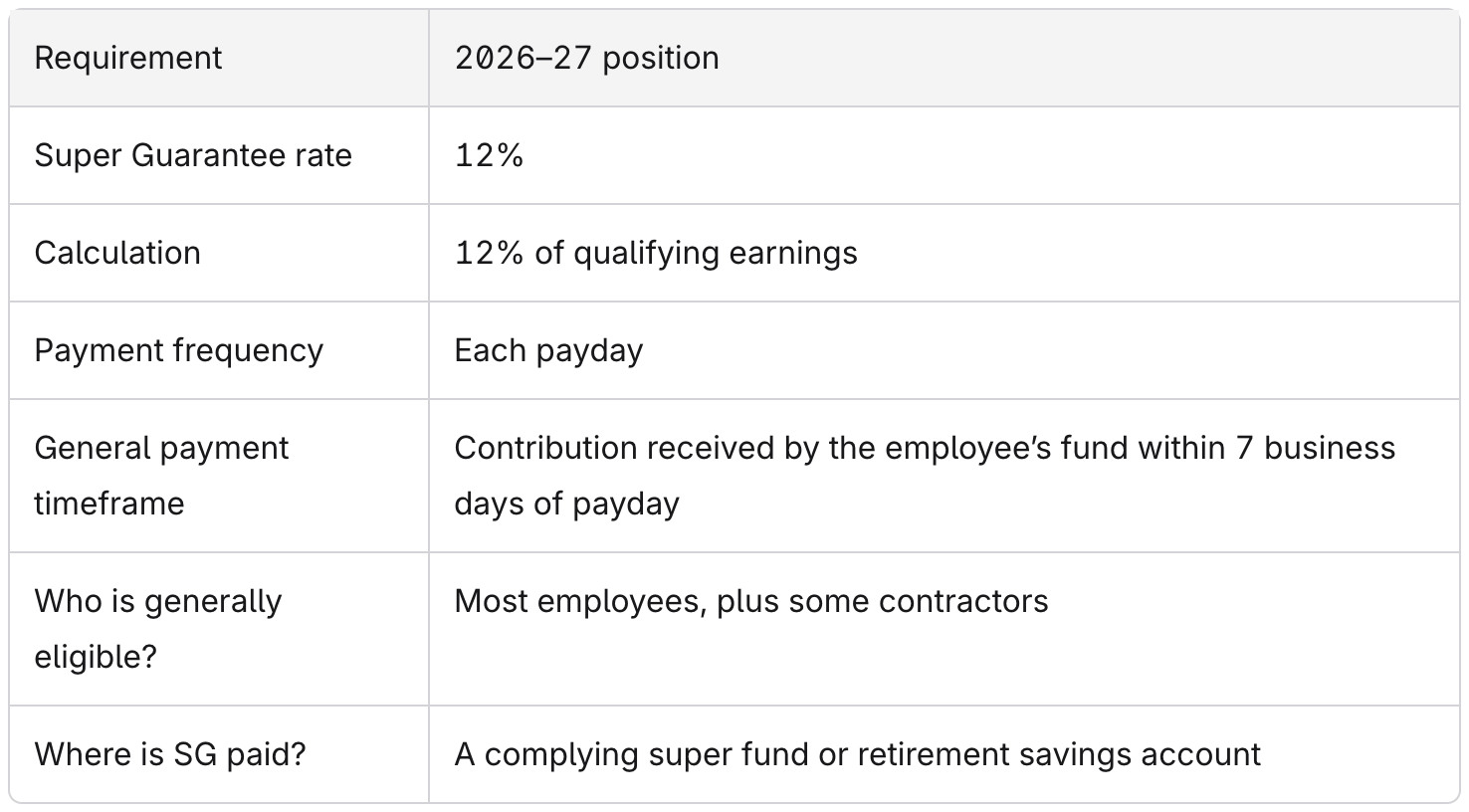
The Australian Taxation Office (ATO) also requires employers to report year-to-date qualifying earnings and their super liability through Single Touch Payroll as part of the system.
What is the Superannuation Guarantee?
The Superannuation Guarantee (SG) is the minimum employer contribution that generally needs to be made for eligible workers in Australia.
These compulsory superannuation contributions help employees build retirement savings over their working lives. Employers make the contribution in addition to an employee’s salary or wages, subject to the terms of their employment arrangements.
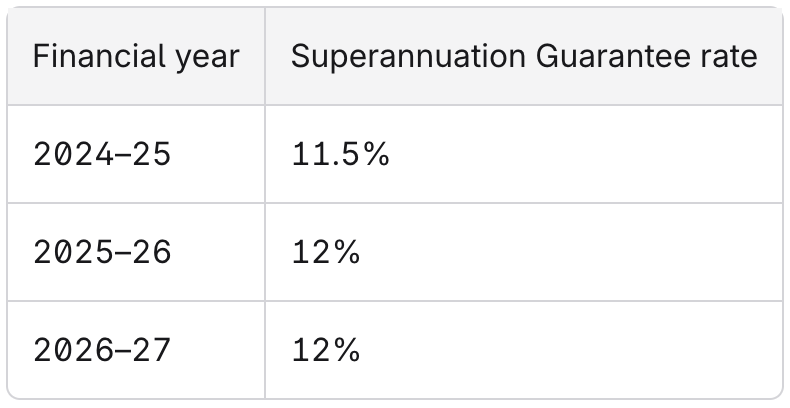
The SG rate increased progressively over a number of years before reaching 12% on 1 July 2025. It remains at 12% for the 2026–27 financial year.
Employers should also check employment contracts and any total remuneration arrangements to understand how superannuation is treated within an employee’s overall package.
Who is eligible for Super Guarantee?
Generally, most employees are eligible for SG, including full-time, part-time and casual employees.
The old $450 per month earnings threshold was removed from 1 July 2022, so adult employees do not need to earn a minimum monthly amount before an employer has an SG obligation.
Different eligibility rules apply in some circumstances. For example, employees under 18 generally need to work more than 30 hours in a week to be entitled to Super Guarantee.
Employers should also take care when classifying workers. Getting the employment relationship wrong can leave a business with unpaid super, interest and other penalties.
Do contractors need to be paid super?
Some contractors can be treated as employees for Superannuation Guarantee purposes.
The Australian Taxation Office says an independent contractor may be entitled to SG where a contract is principally for their labour. Relevant factors include whether the worker is being paid mainly for their personal labour and skills and whether they are required to perform the work themselves.
An ABN or an invoice does not, by itself, mean a contractor is excluded from SG.
This is an area worth reviewing carefully if your business regularly engages sole traders, consultants or labour-only contractors.
How do you calculate Super Guarantee in 2026–27?
From 1 July 2026, employers generally calculate SG as:
Qualifying earnings × 12% = Super Guarantee contribution
For example, if an employee has $3,000 of qualifying earnings for a fortnightly pay period:
$3,000 × 12% = $360 SG
The minimum contribution for that pay period would generally be $360.
What are qualifying earnings?
Qualifying earnings are now used to calculate SG under the Payday Super system.
They bring together ordinary time earnings (OTE) and certain other payments. The ATO identifies qualifying earnings as including OTE, commissions, salary sacrifice amounts and relevant payments to workers who fall within the extended definition of employee, including some contractors paid for their labour.
That makes correctly configuring payroll systems particularly important.
What are ordinary time earnings?
Ordinary time earnings are broadly amounts paid for an employee’s ordinary hours of work.
OTE can include salary or wages for ordinary hours and certain bonuses, commissions, allowances and paid leave.
Clearly identified overtime performed outside ordinary hours is generally not OTE. However, because qualifying earnings now extend beyond OTE alone, employers should check the treatment of each payroll category rather than assuming an amount is excluded from SG simply because it is not ordinary wages.
Your payroll software should be configured so the correct earnings categories are included when it calculates the SG amount.
What changed with Payday Super?
The biggest change from 1 July 2026 is when employers need to pay SG.
Previously, the law generally required employers to make Super Guarantee payments at least quarterly. Under Payday Super, SG is now linked to regular pay cycles.
Whether your employees are paid weekly, fortnightly or monthly, their super contributions are now made in connection with each payday. Contributions generally need to reach the employee’s super fund within seven business days after payday.
That distinction matters.
It is not enough to wait until the seventh business day to initiate a payment if processing times mean the money will reach the fund later. Employers need to understand how long their payroll provider, clearing house or payment method takes to process a contribution.
Why does Payday Super matter for cash flow?
Moving from quarterly contributions to payday contributions changes the timing of a business’s cash outflows.
The overall SG rate has not increased, but employers can no longer retain the money until the end of a quarter. Businesses need enough cash flow available to meet their super obligations every time they pay employees.
For businesses with tight working capital, frequent payroll cycles or fluctuating receipts, this makes forward cash flow planning more important.
Where should employers pay super?
Employers generally need to pay SG contributions electronically to an employee’s complying superannuation fund or, where applicable, a retirement savings account (RSA).
A retirement savings account is a type of low-cost account that can receive superannuation contributions.
Employees will often nominate their own super fund. If an eligible new employee does not make a choice, an employer may need to request their stapled super fund details from the ATO before using the employer’s default fund.
Accurate fund details are now particularly important because there is less time to correct rejected payments before the SG due date.
Employers should periodically check:
- employee names, tax file numbers and fund details are correct
- the nominated fund remains able to accept contributions
- payroll and SuperStream information matches
- rejected contributions are identified and corrected quickly.
The ATO’s Small Business Superannuation Clearing House permanently closed on 1 July 2026, so former users need to make payments through another SuperStream-compliant service.
What if an employee makes extra super contributions?
Employees can choose to put extra money into super, either through salary sacrifice or by making personal contributions themselves.
These extra contributions do not replace the Super Guarantee amount the employer is required to pay.
For example, if an employee earns $3,000 for a fortnight, the employer’s 12% Super Guarantee contribution would be $360.
If the employee also chooses to salary sacrifice $200 into super, the employer still needs to pay the full $360 SG contribution. The extra $200 is added separately, meaning $560 goes into super for that pay period.
The same principle applies if the employee makes personal contributions from their own money. Those contributions are separate and do not reduce the employer’s SG obligation.
Employer SG contributions, salary sacrifice amounts and deductible personal contributions generally fall within the concessional contributions system. Concessional contributions are generally taxed within the fund at 15%, although different tax rules can apply in some circumstances, including for higher-income individuals.
What happens if Super Guarantee is paid late?
Missing a Super Guarantee due date can become expensive quickly.
If SG is not paid in full, on time and to the correct fund, an employer may become liable for the Super Guarantee Charge (SGC).
Under the Payday Super rules, the charge can include the unpaid SG shortfall, notional earnings or interest, an administrative uplift and, in some cases, amounts relating to choice-of-fund failures. The new administrative uplift replaced the old flat administration fee that applied under the quarterly system.
Further penalties may apply if an assessed amount remains unpaid.
Company directors can also become personally liable for unpaid Super Guarantee Charge amounts through a director penalty notice.
Do employers still lodge an SGC statement?
The process changed for SG obligations arising under Payday Super.
For paydays from 1 July 2026, the new system uses voluntary disclosure arrangements where employers identify late or unpaid contributions, rather than relying on the previous quarterly SGC statement process. The ATO can then assess the Super Guarantee Charge.
An SGC statement can still be relevant to historical obligations from before the Payday Super rules commenced. For example, the final quarterly SG period covering April to June 2026 remained subject to the old system.
This is why businesses correcting older super issues need to identify which period the shortfall relates to before applying the current rules.
Can employees report unpaid super?
Yes.
Employees who believe their employer has not paid their super, has paid it late or has paid it to the wrong fund can report unpaid super to the Australian Taxation Office.
The ATO uses information from employees, Single Touch Payroll and super funds to identify potential non-compliance and recover outstanding SG amounts.
Super Guarantee checklist for employers
With SG now closely tied to every pay run, it is worth making super part of your regular payroll review.
Check that your business:
- is applying the 12% SG rate
- has identified all eligible employees and contractors
- is correctly identifying qualifying earnings and ordinary time earnings
- has mapped wages, allowances, commissions, overtime and salary sacrifice correctly in payroll
- is using payroll software that supports the Payday Super rules
- has current employee fund details
- is paying contributions early enough to reach the fund within seven business days
- has a process for identifying and correcting rejected payments
- reconciles SG liabilities against actual payments
- allows for super payments in regular cash flow forecasts
- reviews employment contracts and total remuneration arrangements where relevant
- acts quickly if a contribution is late, incomplete or sent to the wrong fund.
Frequently asked questions about Super Guarantee
What is the Super Guarantee rate for 2026–27?
The Superannuation Guarantee rate is 12% for 2026–27. The SG rate increased from 11.5% to 12% on 1 July 2025 and remains at 12%.
How much super does an employer have to pay?
For paydays from 1 July 2026, employers generally calculate Super Guarantee as 12% of an eligible worker’s qualifying earnings, subject to the applicable rules and limits.
Is Super Guarantee calculated on ordinary time earnings?
Ordinary time earnings remain an important part of the calculation, but from 1 July 2026 SG is calculated using the broader concept of qualifying earnings. Qualifying earnings include OTE as well as certain other payments such as commissions and salary sacrifice amounts.
Is super paid on overtime?
Clearly identified overtime outside an employee’s ordinary hours is generally not ordinary time earnings. The treatment of individual payments should still be checked against the qualifying earnings rules applying from 1 July 2026.
When does super need to be paid?
Under Payday Super, contributions generally need to reach the employee’s super fund within seven business days of payday. Limited exceptions can apply in particular circumstances.
Does Super Guarantee apply to contractors?
It can. Contractors who are engaged mainly for their personal labour may be treated as employees for SG purposes even where they have an ABN and issue invoices.
Is there still a $450 monthly threshold for super?
No. The $450 per month threshold was removed from 1 July 2022. Other eligibility rules still apply, including special rules for employees under 18.
Can employees make additional contributions themselves?
Yes. Employees can make personal contributions or arrange salary sacrifice contributions in addition to compulsory employer super. Contribution caps and tax rules should be considered before making additional contributions.
Getting Super Guarantee right
The move to Payday Super means employers have less time between calculating an SG liability and getting the money into an employee’s fund.
For many businesses, the biggest risks are now practical ones: incorrect payroll settings, outdated fund information, misclassified workers, rejected payments and not allowing enough processing time before the due date.
A regular review of your payroll systems, employee eligibility and payment processes can help identify problems before they turn into unpaid super, additional interest or penalties.
If you’re unsure whether your business is calculating or paying Super Guarantee correctly, Bonerath & Co. can help review your payroll setup and employer superannuation obligations.
Contact our team to discuss your business and payroll requirements.
This information is general in nature and does not take into account your individual circumstances. Superannuation and tax legislation can change, and professional advice should be obtained where appropriate. Information is current as at September 2026.
.png)